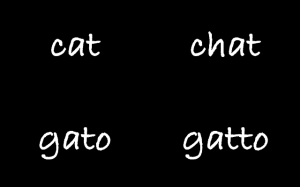
Whisker in Other Languages


graphic from Ali Noel Vyain

This month’s cat vocabulary is the word whisker. A very important thing to a cat. Probably helps them maintain their balance anywhere they might be walking. They are also an attractive looking feature to any cat.

Saying Whisker in European Languages (source)

Language Ways to say whisker
Albanian: mustaqe
Basque: whisker
Belarusian: бакенбарды
Bosnian: dlaka
Bulgarian: мустак
Catalan: bigoti
Croatian: dlaka
Czech: Whisker
Danish: bakkenbart
Dutch: snorhaar
Estonian: põskhabe
Finnish: parta
French: Moustache
Galician: suízas
German: Whisker
Greek: γενειά(geneiá)
Hungarian: darukar
Icelandic: Whisker
Irish: whisker
Italian: baffo
Latvian: ūsas
Lithuanian: siūlinis kristalas
Macedonian: мустак
Maltese: whisker
Norwegian: værhår
Polish: Wąsy
Portuguese: Bigode
Romanian: mustăţi
Russian: бакенбарды(bakenbardy)
Serbian: длака(dlaka)
Slovak: chlp
Slovenian: Dlak
Spanish: Bigote
Swedish: morrhår
Ukrainian: бакенбарди(bakenbardy)
Welsh: trwch blewyn
Yiddish: ווהיסקער

Claw in Other Languages


graphic from Ali Noel Vyain

This month’s cat vocabulary is the word claw. An important item to any cat. They spend lots of time grooming and sharpening them for use. We hope as pampered house cats they won’t need them as much as they would if they were fending for themselves outside.

Having claws ensures they will stop when they jump up to a high place. And if we tell them their claws are too sharp and hurt us, they learn to keep them retracted when they play with us.

Saying Claw in European Languages (source)

Language Ways to say claw
Albanian : thua
Basque: atzapar
Belarusian: кіпцюр
Bosnian: kandža
Bulgarian: нокът
Catalan: urpa
Croatian: kandža
Czech: dráp
Danish: klo
Dutch: klauw
Estonian: küünis
Finnish: kynsiä
French: griffe
Galician: garra
German: Klaue
Greek: δαγκάνα(dankána)
Hungarian: karom
Icelandic: Kló
Irish : claw
Italian: artiglio
Latvian: ķetna
Lithuanian: letena
Macedonian: ноктот
Maltese: irkupri
Norwegian: klo
Polish: pazur
Portuguese: garra
Romanian: Gheară
Russian: коготь(kogot’)
Serbian: канџа(kandzha)
Slovak: pazúr
Slovenian: krempelj
Spanish: garra
Swedish: klo
Ukrainian: кіготь(kihot’)
Welsh: grafanc
Yiddish: קרעל

Paw in Other Languages


graphic from Ali Noel Vyain

This month’s cat vocabulary is the word paw. Cats usually have four to work with. They tend to fall and flip themselves over to land on all four. Or however they do it. Once I saw Sir Socks jump over me as I was lying on a twin sized bed to see him just before he landed in a half sitting half standing position that cats do. His fur was blown back by the wind.

He was always quite graceful whenever he jumped. It’s amazing to watch him in action.

Saying Paw in European Languages (source)

Language Ways to say paw
Albanian: dorëshkrim
Basque: paw
Belarusian: лапа
Bosnian: šapa
Bulgarian: лапа
Catalan: pota
Croatian: šapa
Czech: tlapka
Danish: pote
Dutch: poot
Estonian: käpp
Finnish: tassu
French: patte
Galician: pata
German: Pfote
Greek: πόδι ζώου(pódi zóou)
Hungarian: mancs
Icelandic: Paw
Irish : lapa
Italian: zampa
Latvian: ķepa
Lithuanian: letena
Macedonian: шепа
Maltese: paw
Norwegian: labb
Polish: łapa
Portuguese: pata
Romanian: labă
Russian: лапа(lapa)
Serbian: шапа(shapa)
Slovak: labka
Slovenian: tačk
Spanish: pata
Swedish: Tass
Ukrainian: лапа(lapa)
Welsh: paw
Yiddish: לאַפּע

Love in Other Languages


graphic from Ali Noel Vyain

This month’s cat vocabulary is the word love. One of the most important things in anyone’s life. It doesn’t matter if you’re human or a cat or anything else. None of us can live without love. Especially after ill treatment.

Love cures most ills and cats know this very well. They have shown me over the years how important love is. I am forever grateful to them for that.

Saying Love in European Languages (source)

Language Ways to say love
Albanian: dashuri
Basque: maite
Belarusian: каханне
Bosnian: ljubav
Bulgarian: обичам
Catalan: amor
Croatian: ljubav
Czech: milovat
Danish: elsker
Dutch: liefde
Estonian: armastus
Finnish: rakkaus
French: amour
Galician: amor
German: Liebe
Greek: αγάπη(agápi)
Hungarian: szerelem
Icelandic: Ást
Irish: grá
Italian: amore
Latvian: mīlestība
Lithuanian: meilė
Macedonian: љубов
Maltese: imħabba
Norwegian: kjærlighet
Polish: miłość
Portuguese: amor
Romanian: dragoste
Russian: люблю(lyublyu)
Serbian: љубав(ljubav)
Slovak: milovať
Slovenian: ljubezen
Spanish: amor
Swedish: kärlek
Ukrainian: любов(lyubov)
Welsh: cariad
Yiddish: ליבע

Furever Human


graphic from Ali Noel Vyain

This month’s cat vocabulary is a term from Twitter known as furever human which means the human a cat gets to live with for the rest of their lives after living in a shelter.

Cats tend to get excited when they meet their furever human or even humans. They just know when they smell us. When they see us. They try to get our attention to let us know they know. Or at least it’s something like that. When I met Nuri for the first time, she was in a shelter. She was off by herself. I saw her alone. So, I walked over to her and as soon as my shadow fell over her, she looked up and started talking to me.

It doesn’t matter what she was telling me at the time. It was as if she knew who I was to her. She was just having a causal chit chat with a friend. I picked her up briefly and she didn’t complain.

When I was asked later which cat I wanted, I asked for her. She came home with me and that was that. Yes, it still took her time to adjust to her new home. It took us time to get used to each other.

We’ve been happy ever since.

Furever Home


graphic from Ali Noel Vyain

This month’s cat vocabulary is a term from Twitter known as furever home which means the home that cat gets for the rest of their life after living in a shelter.

Some cats don’t even make it to a shelter. Sometimes they find themselves homeless and not liking living on the streets. So, they wander around the neighborhood looking for their furever home. Some tend to find one by recognizing the signs of crazy cat people. Not that the humans always know it. Sometimes they find a way inside the house and settle in and wait for the human to show.

Much like the ones who are in shelters waiting for someone to come and adopt them. It’s hard to say how long they wait. It seems easier when they are kittens. When they become seniors, their odds of getting adopted decrease significantly. But seniors cats need homes too. They probably need something quiet and relaxing as their lives wind down. It just all depends upon the cat.

So, if you want or need a cat, please go to your local shelter first. Chances are good that you will find at least one good companion who needs love as much as you do.

Shelter in Other Languages


graphic from Ali Noel Vyain

This month’s cat vocabulary is the word shelter. Not always a good word to a cat who’s homeless and in need of love and healthcare, but things could be much worse for the cat if they are left outside to die.

Many cats aren’t happy to be caught and taken to a shelter, but some adjust to their new environment fairly quickly. It doesn’t take them long to learn that they will be cared for and they can interact with other cats.

Another plus is that they can be adopted and taken home to live with someone who will adore them for the rest of their lives. So, they make the best of it and wait.

I think shelters can be the best way to find a cat companion that I cannot live without for long. So, even if my current beloved cat has died, you may find me at the shelter fairly soon to find another cat.

Saying Shelter in European Languages (source)

Language Ways to say shelter
Albanian: strehë
Basque: aterpe
Belarusian: сховішча
Bosnian: sklonište
Bulgarian: приют
Catalan: abric
Croatian: sklonište
Czech: přístřeší
Danish: ly
Dutch: schuilplaats
Estonian: katusealune
Finnish: suoja
French: abri
Galician: abrigo
German: Schutz
Greek: καταφύγιο(katafýgio)
Hungarian: menedék
Icelandic: Skjól
Irish: foscadh
Italian: riparo
Latvian: pajumte
Lithuanian: pastogė
Macedonian: засолниште
Maltese: kenn
Norwegian: husly
Polish: schron
Portuguese: abrigo
Romanian: adapost
Russian: укрытие(ukrytiye)
Serbian: склониште(sklonishte)
Slovak: prístrešia
Slovenian: zavetišče
Spanish: abrigo
Swedish: skydd
Ukrainian: укриття(ukryttya)
Welsh: lloches
Yiddish: באַשיצן

Vaccine in Other Languages


graphic from Ali Noel Vyain

This month’s cat vocabulary is the word vaccine. I don’t know of anyone who likes to get shots for anything, but sometimes we do need them. As long as we don’t have any adverse reactions to the vaccine, they should help us stay healthy and prevent serious health problems from occurring.

For cats, that means a rabies vaccine and perhaps a few others. It is a good idea to make sure they have their vaccine so they don’t go crazy and bite random humans for no real reason.

I’m just happy that when they get their shots, it doesn’t take very long and they do get over it fairly quickly. It seems to help when whoever gave them the shot distracts them with some playful way.

Saying Vaccine in European Languages (source)

Language Ways to say vaccine
Albanian: vaksinë
Basque: txerto
Belarusian: вакцына
Bosnian: vakcina
Bulgarian: ваксина
Catalan: vacuna
Croatian: cjepivo
Czech: vakcína
Danish: vaccine
Dutch: vaccin
Estonian: vaktsiin
Finnish: rokote
French: vaccin
Galician: vacina
German: Impfstoff
Greek: εμβόλιο(emvólio)
Hungarian: vakcina
Icelandic: Bóluefni
Irish : vacsaín
Italian: vaccino
Latvian: vakcīna
Lithuanian: vakcina
Macedonian: вакцина
Maltese: vaċċin
Norwegian: vaksine
Polish: szczepionka
Portuguese: vacina
Romanian: vaccin
Russian: вакцина(vaktsina)
Serbian: вакцина(vakcina)
Slovak: vakcína
Slovenian: cepivo
Spanish: vacuna
Swedish: vaccin
Ukrainian: вакцина(vaktsyna)
Welsh: brechlyn
Yiddish: וואַקצין

Vet in Other Languages


graphic from Ali Noel Vyain

This month’s cat vocabulary is the word vet. Not someone cats always like, but have to deal with at times. I don’t blame cats for not liking the vet. I don’t care to see doctors that much either.

But sometimes it is necessary. Check ups can be helpful especially if a cat doesn’t complain when something goes wrong inside of their bodies. Cats are famous for hiding their various ailments and illnesses so that other predators don’t know.

It’s a survival instinct. I can’t say I blame them. It’s not always good to complain about every little thing. It will just make us all sicker and more miserable.

Depending upon what it is, we and cats can get better with or without medical intervention. We just have to make sure we can take care of ourselves and know when it’s time to ask for help.

Saying Vet in European Languages (source)

Language Ways to say vet
Albanian: veteriner
Basque: albaitaria
Belarusian: ветэрынарны ўрач
Bosnian: veterinar
Bulgarian: ветеринар
Catalan: veterinari
Croatian: veterinar
Czech: Vet
Danish: dyrlæge
Dutch: dierenarts
Estonian: loomaarst
Finnish: eläinlääkäri
French: vétérinaire
Galician: veterinario
German: Tierarzt
Greek: κτηνίατρος(ktiníatros)
Hungarian: állatorvos
Icelandic: Dýralæknir
Irish: VET
Italian: veterinario
Latvian: veterinārs
Lithuanian: veterinaras
Macedonian: ветеринар
Maltese: vet
Norwegian: veterinæren
Polish: weterynarz
Portuguese: veterinario
Romanian: veterinar
Russian: ветеринарный врач(veterinarnyy vrach)
Serbian: ветеринар(veterinar)
Slovak: zverolekár
Slovenian: vet
Spanish: veterinario
Swedish: veterinär
Ukrainian: ветеринарний лікар(veterynarnyy likar)
Welsh: milfeddyg
Yiddish: וועטערינאַר

Pet in Other Languages


graphic from Ali Noel Vyain

This month’s cat vocabulary word is pet. Cats can be pets that we never own. Of course knowing cats, they probably think of us as their pets. Sometimes they look after us. When I was suffering from a concussion and post-concussion, Nuri tended to cuddle up to me and purr whenever I was resting on my still point inducer to help me recover.

She was so sweet. She never complained if I forgot to clean out her litter box. I’d feel bad about forgetting and tried to clean it out as often as I could remember.

Pets can and do keep us from being lonely. Sometimes that’s worth more than what we spend on them to take care of them.

Saying Pet in European Languages (source)

Language Ways to say pet
Albanian: manar
Basque: maskota
Belarusian: хатняе жывёліна
Bosnian: kućni ljubimac
Bulgarian: домашен любимец
Catalan: acariciar
Croatian: ljubimac
Czech: Pet
Danish: kæledyr
Dutch: huisdier
Estonian: lemmikloom
Finnish: lemmikki-
French: animal de compagnie
Galician: mascota
German: Haustier
Greek: κατοικίδιο ζώο(katoikídio zóo)
Hungarian: házi kedvenc
Icelandic: Gæludýr
Irish: peataí
Italian: animale domestico
Latvian: apmīļot
Lithuanian: glamonėti
Macedonian: миленик
Maltese: domestiċi
Norwegian: kjæledyr
Polish: zwierzę domowe
Portuguese: animal
Romanian: animal de companie
Russian: домашнее животное(domashneye zhivotnoye)
Serbian: Кућни љубимац(Kuchni ljubimac)
Slovak: domáce zviera
Slovenian: hišne živali
Spanish: mascota
Swedish: sällskapsdjur
Ukrainian: домашня тварина(domashnya tvaryna)
Welsh: anifeiliaid anwes
Yiddish: ליבלינג

Website Powered by WordPress.com.

Up ↑

Design a site like this with WordPress.com
Get started